International Literacy Day Reading: Empowering Minds and Shaping Futures
International Literacy Day, observed annually on September 8, is a global celebration of the transformative power of reading. This day serves as a reminder of the critical role literacy plays in personal development, societal progress, and economic growth. For educators, especially those working with Grades 5–6 students, this occasion presents an excellent opportunity to integrate meaningful learning experiences that not only enhance reading comprehension but also foster a lifelong appreciation for knowledge.
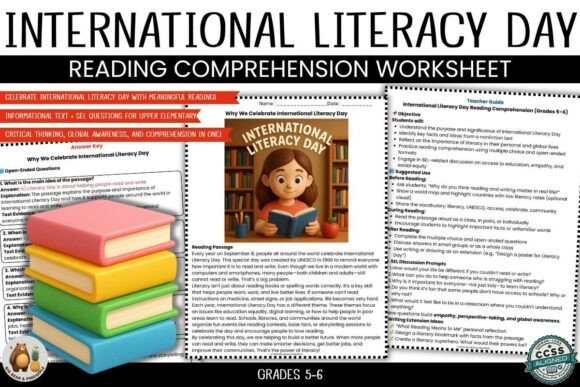
The International Literacy Day Reading Comprehension – Grades 5–6 Nonfiction Passage Questions WS0378 is a carefully crafted educational resource designed to align with the goals of this significant day. It offers a concise yet informative nonfiction passage that delves into the purpose, history, and global impact of International Literacy Day. This activity supports upper elementary students in developing essential reading skills through a blend of multiple-choice and open-ended questions, encouraging them to reflect on the importance of literacy in their lives and the world around them.
Why International Literacy Day Matters Today
In an era where digital content dominates our daily lives, the fundamentals of reading remain more crucial than ever. While technology has made information more accessible, it has also introduced challenges such as decreased attention spans and the need for critical thinking skills. International Literacy Day highlights the ongoing relevance of reading in navigating these changes and ensuring that individuals can engage thoughtfully with the world.
For educators, incorporating activities like the WS0378 resource allows for a seamless integration of literacy education with broader themes such as social studies, global awareness, and emotional intelligence. The passage provides a foundation for students to explore the historical context of International Literacy Day, while the accompanying questions encourage deeper analysis and reflection.
Enhancing Learning Through Structured Activities
The Nonfiction Passage included in the WS0378 resource is approximately 250 words long and is tailored to be both engaging and informative. It introduces students to the significance of literacy as a human right and its role in promoting equity and inclusion. The 5 Multiple Choice Questions are designed to assess students’ understanding of key concepts, while the 5 Open-Ended Questions invite them to think critically about the broader implications of literacy.
These questions are aligned with CCSS Standards RI.5.1 and RI.6.1, which emphasize the ability to quote accurately from a text, and RI.5.2 and RI.6.2, which focus on determining a text’s main idea. By engaging with these standards, students build foundational skills that are essential for academic success and lifelong learning.
Supporting Educators with Practical Tools
The Answer Key with Text Evidence Scoring Notes ensures that teachers can efficiently evaluate student responses while reinforcing the importance of citing evidence from the passage. Additionally, the Teacher Guide with SEL Prompts provides valuable strategies for integrating social-emotional learning (SEL) into classroom discussions. These prompts encourage students to reflect on how literacy impacts their own lives and the communities they belong to.
The Differentiation Tips included in the guide help educators adapt the activity to meet the diverse needs of their students. Whether used as a morning work assignment, a sub plan, or part of a center rotation, the WS0378 resource is versatile and easy to implement. Teachers can also upload the materials to digital platforms such as Google Slides or Seesaw, making it ideal for blended learning environments.
Encouraging Reflection and Action
One of the most valuable aspects of the WS0378 activity is its emphasis on reflection. Students are encouraged to consider how literacy affects their daily lives and the opportunities it creates. This reflective component is particularly important in today’s fast-paced world, where the ability to read critically and communicate effectively is increasingly valued.
By extending the activity with writing prompts or class discussions on global education, educators can further deepen students’ understanding of the topic. These extensions provide opportunities for students to express their thoughts creatively and connect their learning to real-world issues.
Adapting to Modern Educational Needs
As educational practices continue to evolve, resources like the WS0378 activity offer a practical way to address the changing needs of students. With a growing emphasis on interdisciplinary learning and critical thinking, this resource seamlessly integrates literacy education with social studies and SEL. It also aligns with current trends in education that prioritize student engagement and active learning.
Moreover, the use of a Horizontal 3D Illustration adds a visual element that enhances the learning experience, making the content more accessible and engaging for young readers. This feature supports different learning styles and helps reinforce key concepts through imagery.
Conclusion
International Literacy Day Reading is more than just a celebration of books—it is a call to action for educators, students, and communities to recognize the power of literacy in shaping the future. The International Literacy Day Reading Comprehension – Grades 5–6 Nonfiction Passage Questions WS0378 provides a comprehensive and adaptable tool for teaching this important topic. By incorporating this resource into their curriculum, educators can empower students to become confident readers, thoughtful thinkers, and active participants in a literate society.
Whether used as a literacy mini-lesson on or before September 8 or integrated throughout the school year, this activity offers a meaningful way to celebrate the enduring value of reading. As we continue to navigate an ever-changing world, fostering strong reading skills remains one of the most impactful ways to support personal and collective growth.